


From $50,000 Crowdfunding Goal To The Oscars: Usman Riaz Reveals The Decade Behind The Glassworker At SACC 2026
What began as one Pakistani artist’s ambition to make a hand-drawn animated film in his home country became a decade-long effort to build the skills, team and infrastructure needed to make it possible.
At the Sharjah Animation and Comics Conference (SACC 2026), director Usman Riaz traced the journey behind his debut feature The Glassworker, from a conversation in a car in Karachi in 2014 and an early crowdfunding campaign to the creation of Mano Animation Studios and the film’s eventual selection as Pakistan’s submission for Best International Feature Film at the 97th Academy Awards.
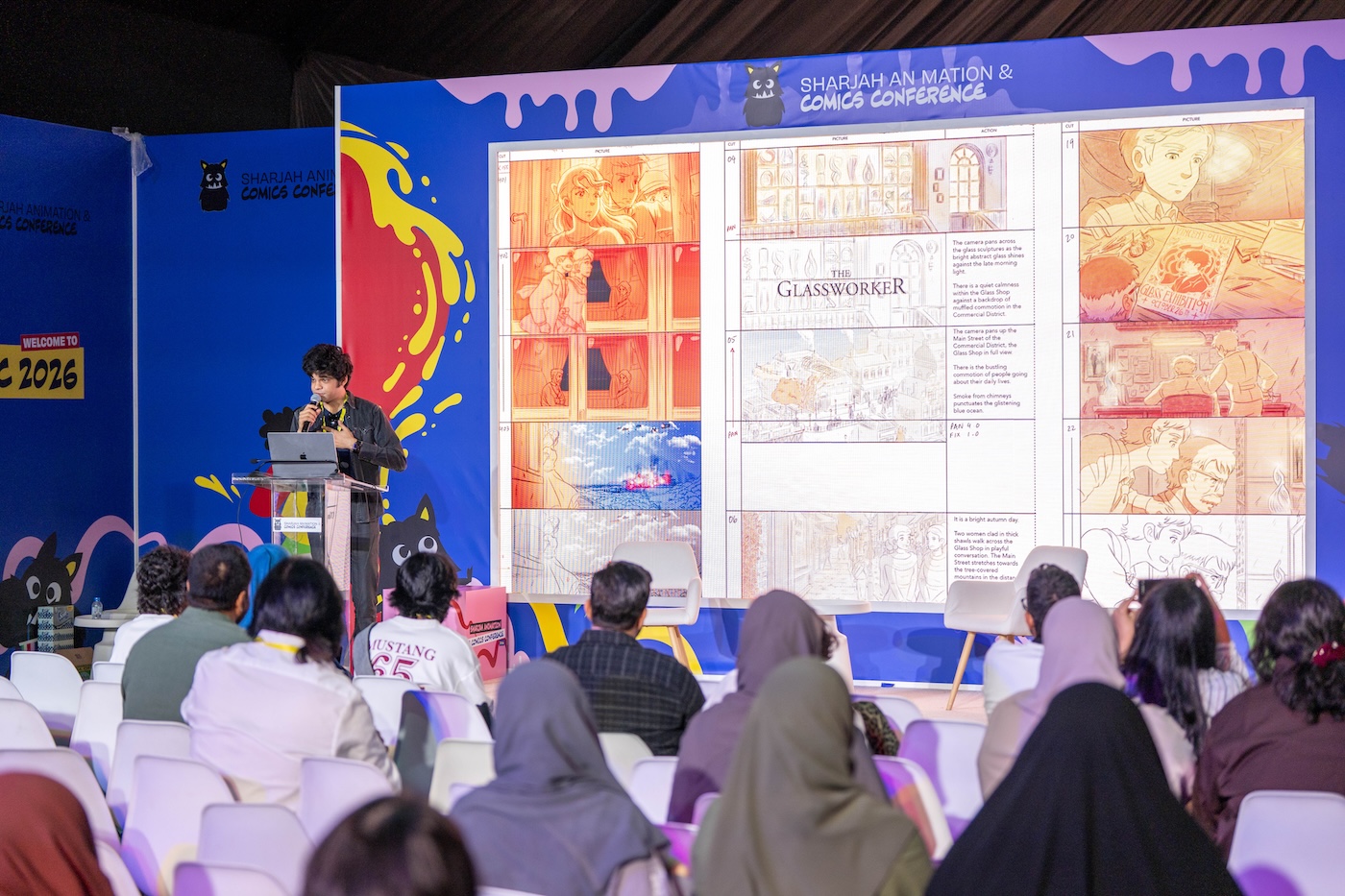
During the session 10 Years of Making The Glassworker, moderated by Yasmeen Sinan, Riaz used drawings, visual development material and film clips to show how the project evolved while a team of artists and specialists was assembled in Pakistan and internationally.
Riaz said founding Mano Animation Studios fulfilled a childhood ambition shaped by films from Studio Ghibli and Disney. A visit to Studio Ghibli in Japan gave him further confidence to pursue hand-drawn animation in Pakistan despite limited specialist expertise and the challenge of convincing investors to back an unfamiliar production model.
When conventional financing proved difficult, the team turned to crowdfunding, initially seeking USD 50,000 for a proof of concept. The campaign raised more than twice that amount, enabling them to create a six-minute pilot that helped attract further expertise and financial backing.
The scale of the production became clear in the storyboarding alone. Riaz spent 19 months developing 1,477 shots across approximately 2,400 drawings, before editing an initial 118-minute animatic down to 96 minutes.
With the narrative spanning 15 years, visual details also had to register the passage of time and changes in the characters’ surroundings. Riaz demonstrated this through the glass shop at the heart of the film, which gradually shifts from a space filled with decorative pieces to one marked by fewer displays and blackout curtains as conflict encroaches on everyday life.
The fictional world also draws heavily on Karachi’s architecture, markets, alleyways and colourful textiles. To accurately portray the craft at the centre of the story, the team visited a glassmaking workshop in London to study how molten glass moves and how artisans physically work with the material.
Riaz also spoke about building a production team in which several members began without professional animation experience. Years of training, experimentation and painstaking attention to movement followed, while the director himself faced moments when he considered abandoning the project.
Passion, he said, ultimately kept the film alive.
Reflecting on The Glassworker becoming Pakistan’s submission to the Academy Awards, Riaz said his goal from the beginning had gone beyond completing one film. He wanted to create something that could inspire another generation in the way animated films had inspired him as a child.